Showing posts with label Cricketers. Show all posts

Friday, August 22, 2008

Anil Kumble


Anil Radhakrishna Kumble ( (born 17 October 1970 in Bangalore, Karnataka) is an Indian cricketer. He is a right-arm leg spin (legbreak googly) bowler and a right-hand batsman. He is currently the leading wicket-taker for India in both Test and One Day International matches. At present he is the third highest wicket-taker in Test cricket and one of only three bowlers to have taken more than 600 Test wickets. Kumble has had success bowling with other spinners, notably Venkatapathy Raju and Rajesh Chauhan in the 1990s and Harbhajan Singh since 2000.

Kumble was appointed the captain of the Indian Test cricket team on 8 November 2007. His first assignment as captain was the three-test home series against Pakistan that India won 1-0. Then he led the Indian Test team on its tour to Australia for the 2007-08 four-test series of The Border-Gavaskar Trophy that India lost 1-2. Kumble succeeds his state team mate Rahul Dravid, who resigned as the captain in September 2007 . Since his debut in international cricket in April 25, 1990, he has taken over 600 Test wickets and 330 ODI wickets. Although often criticized as not a big turner of the ball, Kumble is the second highest wicket taker among leg spinners in Test cricket behind leg spinner Shane Warne of Australia and the third of all bowlers after Warne and off spinner Muttiah Muralitharan of Sri Lanka and has claimed over 600 Test wickets. He is one of only two bowlers in the history of cricket to have taken all 10 wickets in a test innings, the other being Jim Laker of England. Kumble is currently ranked the 5th best bowler in Tests by the International Cricket Council. He was awarded the Padma Shri, one of India's highest civilian honours, by the Government of India in 2005.

No bowler in history has won India more Test matches than Anil Kumble, and there probably hasn't been a harder trier either. Like the great tall wristspinners Bill O'Reilly and his own idol BS Chandrasekhar, Kumble trades the legspinner's proverbial yo-yo for a spear, as the ball hacks through the air rather than hanging in it and comes off the pitch with a kick rather than a kink. It is a method that has provided him stunning success, particularly on Indian soil, where his deliveries burst like packets of water upon the feeblest hint of a crack, and more than one modern-day batsman has remarked that there is no more difficult challenge in cricket than handling Kumble on a wearing surface.

Kumble's prodigious capacity to bear pain was proved in Antigua in 2002 when he bandaged his fractured jaw to deliver a stirring spell, and that to continuously learn when, in the mid-2000s, after a decade of middling away performances, he influenced memorable wins in Headingley, Adelaide, Multan and Kingston, using an improved googly, bigger sidespin and more variation in flight and on the crease.

In a brilliant though always downplayed career Kumble has claimed virtually every Indian record. In 1999 in Delhi he swallowed all ten wickets in an innings against Pakistan. In December 2001, on home turf in Bangalore, he became the India's first spinner to take 300 Test wickets. A year later, almost to the day, he became the first to do so in one-dayers. In August 2007 at The Oval he went past Glenn McGrath's 563 wickets and in January 2008 he broke the 600 barrier, to stand behind only Shane Warne and Muttiah Muralitharan, emphasising his contribution to spin's golden era. And at The Oval he chalked up what, judging by the pure ecstasy of his reaction and the dressing room's, was perhaps his most cherished feat of all - a Test century that had been 17 years and 118 matches in the coming.

Less than a month after his 37th birthday, though, he received the ultimate honour when he was named India's Test captain for the home series against Pakistan. He went on to win the series, the first home triumph against Pakistan in 27 years, before playing a big role in holding the side together during the controversial series in Australia.

An unorthodox, right arm leg spin bowler, this tall, bespectacled (now contact lens-ed), captain of Karnataka, who started life as a medium-pacer is India`s most effective strike bowler in both Tests and ODIs. The onl bowler other than Jim Laker to take 10 wickets in an innings, a feat not easy to achieve. He made his debut in England in 1990, alongside Narendra Hirwani, raising hopes of a resurgence in the art of leg-spin. But it was not until his recall against South Africa sixteen months later that he proved his abilities on the International stage. Since then he went from strength to strength. It is his well concealed googly and flipper, along with his genuine medium-pace faster balls that are his strike weapons rather than the leg-break which he turns little. He is unfailingly economical and in the 1995 English county season became the first bowler in 5 years to capture more than 100 wickets. A useful lower-order batsmen, with first-class centuries to his credit, Kumble has often done a sterling job holding up the sagging tail for India. Suffering from being over-bowled, Kumble recieved a well deserved rest from the national side in 1997, missing the tour of Sri Lanka and the Sahara Cup but was recalled to the national side to face Sri Lanka.

Yuvraj Singh


Yuvraj Singh , born 12 December 1981 in Chandigarh, India) is a cricketer from India, and the son of former Indian fast bowler and Punjabi movie star Yograj Singh. He has been a member of the Indian cricket team since 2000 (ODIs) and played his first Test match in 2003. He is the current vice captain of the ODI team. At the 2007 World Twenty20 he hit six sixes in an over against England's Stuart Broad - a feat only performed three times previously in any form of senior cricket, and never previously in an international match between two Test cricket nations.

Generously gifted, Yuvraj Singh is looked upon as a strong, fearless natural destined for great things. Two months short of his 19th birthday, he made an almost messianic entry into international cricket, toppling Australia in the Nairobi Mini-World Cup in 2000-01, with a blistering 84 and some scintillating fielding. In time he was to supplement these skills with clever, loopy left-arm spin. While Yuvraj's ability to hit the ball long and clean were instantly recognised, he was soon found to be troubled by quality spin and perceived to lack commitment, traits for which he temporarily lost his place in the one-day side. But on returning, for the last two one-dayers against Zimbabwe in early 2002, he swung the series India's way with a matchwinning innings in each game, and then went to England and played a key role in three Indian chases in their dream run in the NatWest tri-series. It took 15 months more, and an injury to his captain, Sourav Ganguly, for Yuvraj to get a Test look-in. On the third such opportunity, against Pakistan on the first day on a greentop at Lahore, he stroked a stunning century off 110 balls. The 2005-06 season proved to be a watershed for Yuvraj, with 1161 runs at 58 in the one-dayers, as he transformed himself into one of the keystones in India's batting line-up. He was soon preferred over VVS Laxman in Tests when India went in with five batsmen, but a lean series in the West Indies meant that he was still struggling to match potential with performance. Yuvraj picked up his form in one-day cricket, and overcame a knee injury sustained before the 2006 ICC Champions Trophy to book a spot to the 2007 World Cup. India were knocked out early, but Yuvraj continued his form through the year. There were two highlights in the second half of the year: the first, a record six sixes in one Stuart Broad over in a 12-ball fifty during India's fairytale run at the inaugural ICC World Twenty20 in South Africa, and an awesome Test hundred against Pakistan at Bangalore, which swung the momentum back India's way. Yuvraj was included in India's Test squad for a four-Test series in Australia. He then captained Kings XI Punjab to the semi-finals of the IPL.


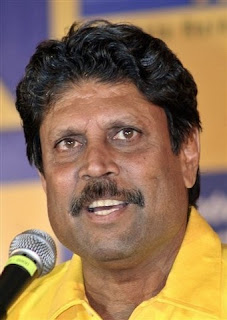
Kapil Dev was born to Ram Lal Nikhanj and Raj Kumari Lajwanti (maiden name) on 6 January 1959. He was the sixth of seven siblings. Kapil's parents had emigrated from a village near Rawalpindi during Partition. Ram Lal Nikhanj settled in Chandigarh and settled into a prosperous building and timber business. Kapil Dev was a student at D.A.V. School and in 1971 joined Desh Prem Azad. He was introduced to Romi Bhatia by a common friend in 1979 and proposed to her in 1980. Kapil Dev married Romi in 1980 and the couple have a daughter Amiya Dev who was born in 1996.

Kapil Dev Ramlal Nikhanj (born 6 January 1959, Chandigarh), better known as Kapil Dev, is a former Indian cricketer regarded as one of the greatest all-rounders of all time. He was captain when India won the world cup in 1983. Kapil Dev was named by Wisden as the Indian Cricketer of the Century in 2002. Kapil Dev had a rather prosaic stint as India's national cricket coach for 10 months between October 1999 and August 2000.

Kapil was a right-arm pace bowler noted for his graceful action and potent outswinger, and was India's main strike bowler throughout most of his career. He also developed a fine inswinging yorker during the 1980s which he used very effectively against tail-enders. As a batsman he was a natural striker of the ball who could hook and drive effectively. A naturally aggressive player, he often helped India in difficult situations by taking the attack to the opposition. His nickname was The Haryana Hurricane — he used to represent the Haryana cricket team.

Kapil Dev was the greatest pace bowler India has produced, and their greatest fast-bowling allrounder. If he had played at any other time - not when Imran Khan, Ian Botham and Richard Hadlee were contemporaries - he would surely have been recognised as the best allrounder in the world. In any case he did enough to be voted India's Cricketer of the Century during 2002, ahead of Sunil Gavaskar and Sachin Tendulkar. His greatest feats were to lead India almost jauntily, and by his allround example, to the 1983 World Cup, and to take the world-record aggregate of Test wickets from Hadlee. It was the stamina of the marathon runner that took him finally to 431 wickets and only a yard beyond. He might not have been quite the bowling equal of Imran, Hadlee or Botham at his best, and his strike rate was less than four wickets per Test. But he was still outstanding in his accuracy and ability to swing the ball, usually away from right-handers. And he could hit a ball even more brilliantly than he bowled it, with uncomplicated flair. Kapil had a rather ordinary stint as India's coach for ten months between October 1999 and August 2000. Att the height of the match fixing allegation by Manoj Prabhakar -- a charge that was subsequently dismissed - Kapil resigned as coach. Hurt by the betting controversy, he announced that he was leaving the game. However, he returned from a significantly quiet period when Wisden named him as one of 16 finalists for the Indian Cricketer of the Century award. He won, and then returned to cricket as a bowling consultant and served as chairman of National Cricket Academy for two years. In May 2007, Kapil joined the breakaway Indian Cricket League, which led to his removal from the NCA.


Wednesday, August 13, 2008

Mahendra Singh Dhoni(MS Dhoni)


Mahendra Singh Dhoni or MS Dhoni (born July 7, 1981 in Ranchi, Jharkhand) is an Indian cricketer and the current captain of the Indian Twenty20 and ODI team. Under his captaincy, India won the 2007 ICC World Twenty20 and CB Series of 2007-8.

Passion seeps through his gaze. The stylish hunk of the Indian cricket team has it all, best wicketkeeper, best batsmen with a strong value for teamwork. Unfold the life story of an aggressive right-handed batsman and wicket-keeper, and the Indian ODI Team's vice-captain, Mahendra Singh Dhoni, who has clinged to the throne of glory from the first day.

His Early Days To His Step To Glory:
Mahendra Sigh Dhoni was born on July 7 1981 in Ranchi to Pan Singh and Devaki Devi. He has two siblings, a sister Jayanti Gupta and a brother Narendra. As a child he loved to play Badminton and football. He scored so well in the sports that he was selected at district and club level to achieve greater heights. However the destiny has always taken a varied path to taste sweet success. It drove him to the field of cricket to be recognised as a cricketer than a football or a badminton player.

Although Dhoni had not played cricket, he impressed with his wicket-keeping skills and became the regular wicketkeeper at the Commando cricket club within a short span of time. In his college days he slowly drifted from his childhood interests and focused only on cricket. Based on his performance at club cricket, he was picked for 1997/98 season Vinoo Mankad Trophy Under-16 Championship and he performed admirably

Dhoni, referred to as 'Mahi' by his friends, debuted in the Bihar cricket team during the 1998/99 cricket season and was selected to represent India for a tour to Kenya in 2004. As a child he idolized three people, Cricket teammate Sachin Tendulkar, Bollywood actor Amitabh Bachchan and singer Lata Mangeshkar. In one of the interview he states the pleasure of meeting his idol Mr. Bachchan as the most memorable moment. Besides his love for field sports he also loves to buzz in the streets with his remarkable bikes.

Marketable cricket icon
Dhoni has been riding high on style not just because of his tinted hair but also because of his shimmering smile. He is reputed to have 17 endorsements. From ceiling fans, shoes, electronics, men's fabirc to petrol, he's done it all. In 2006 he was voted MTV Youth Icon. He joins cricketers Rahul Dravid and Sachin Tendulkar in winning the award.He garnered maximum number of votes to win the honour ahead of five other heavyweights -- Navjot Singh Sidhu, Abhijeet Sawant, Vijay Mallaya , President A P J Abdul Kalam and John Abraham.

His quote
"Ranking does not matter. The team is more important. As long as my contributions lead to the team's victories, it is more important than the top ranking,"

His Cricket career
Dhoni burst into the cricket field with complete zest in 2004. He immediately established himself as a swashbuckling batsman besides being a good wicketkeeper. He was credited by critics, 'as the man who can decimate any bowling attack with his powerful hitting'. Dhoni has so far played in 66 One-Day Internationals for India in which he has amassed 1958 runs. He has a highest score of 183 not out which he achieved against Sri Lanka in Nagpur.

Dhoni is known for his awesome strike-rate of 98.49 and averages 46.61 per match. He hit 10 Sixes, the most by an Indian in an Innings, and the second highest in ODI cricket. Till date, he has managed to climb the third spot while Sachin Tendulkar slipped to the 19th in the International Cricket Council (ICC) one-day international ranking till February 2007. However his first trip to world cup did not fetch him any applaud due to his unexpectedly poor performance.


After the loss to Bangladesh in 2007 Cricket World Cup, the house that Dhoni was constructing in his home-town Ranchi was vandalized and damaged by political activists. The local police arranged for security for his family as India exited the World cup in the first round.

With the built in shame and the will to win back the world of fame, Dhoni rose back to his stardom within a years time. Twenty20 match was a blessing to the young Indian team headed by Dhoni to win all that they lost. Under his captaincy, India won the 2007 World Twenty20 against finalist Pakistan Team. He made the attempt to give India the celebration of 1983 World cup. Kudos to the hero who dared to achieve what he dreamt with his humble leadership techniq

Tuesday, August 12, 2008

Rahul Dravid


Rahul Sharad Dravid (b. 11 January 1973) is an Indian cricketer, and a former captain of the Indian national cricket team, of which he has been a regular member since 1996. Dravid is the third Indian batsman, after Sachin Tendulkar and Sunil Gavaskar, to have scored 10,000 runs in test cricket. On February 14, 2007, he became the sixth player in history and the third Indian, after Sachin Tendulkar and Sourav Ganguly, to score 10,000 runs in ODI cricket. In September 2007, he resigned as captain of India team. He is the captain as well as the Icon Player in the Royal Challengers Bangalore team in the Indian Premier League.

Personal life
Dravid was born in Indore, Madhya Pradesh into a Maharashtrian Deshastha family living in Karnataka. His paternal ancestors were Iyers from Thanjavur. He grew up in Bangalore, Karnataka. He speaks Kannada and Marathi, He has a brother named Vijay who works in Cognizant Technology Solutions. Dravid's father worked for Kissan, a company known for jams and preserves and thus he earned the nickname Jammy from his teammates at St. Joseph's, Bangalore. Rahul Dravid has a degree in commerce from St Joseph's College of Commerce Bangalore, Karnataka.
On
May 4, 2003, Rahul married Dr. Vijeta Pendharkar, a surgeon from Nagpur and on October 11, 2005, their son, Samit, was born.

Rahul Dravid, a cricketer who seamlessly blends an old-world classicism with a new-age professionalism, is the best No. 3 batsman to play for India - and might even be considered one of the best ever by the time his career is done. He already averages around 60 at that position, more than any regular No. 3 batsman in the game's history, barring Don Bradman. Unusually for an Indian batsman, he also averages more overseas - around 60, again - than at home. But impressive as his statistics are, they cannot represent the extent of his importance to India, or the beauty of his batsmanship.
When Dravid began playing Test cricket, he was quickly stereotyped as a technically correct player capable of stonewalling against the best attacks - his early nickname was 'The Wall' - but of little else. As the years went by, though, Dravid, a sincere batsman who brought humility and a deep intelligence to his study of the game, grew in stature, finally reaching full blossom under Sourav Ganguly's captaincy. As a New India emerged, so did a new Dravid: first, he put on the wicketkeeping gloves in one-dayers, and transformed himself into an astute finisher in the middle-order; then, he strung together a series of awe-inspiring performances in Test matches, as India crept closer and closer to their quest of an overseas series win.
Dravid's golden phase began, arguably, in Kolkata 2001, with a supporting act, when he made 180 to supplement VVS Laxman's classic effort of 281 against Australia. But from then on, Dravid became India's most valuable player, saving them Tests at Port Elizabeth, Georgetown and Trent Bridge, winning them Tests at Headlingley, Adelaide, Kandy and Rawalpindi. At one point during this run, he carved up four centuries in successive innings, and hit four double-centuries in the space of 15 Tests, including in historic away-wins at Adelaide and Rawalpindi. As India finished off the 2004 Pakistan tour on a winning note, on the back of Dravid's epic 270, his average crept past Sachin Tendulkar's - and it seemed no aberration.
Dravid's amazing run was no triumph of substance over style, though, for he has plenty of both. A classical strokeplayer who plays every shot in the book, he often outscores team-mates like Tendulkar and Laxman in the course of partnerships with them, and while his pulling and cover-driving is especially breathtaking, he has every other shot in the book as well. He is both an artist and a craftsman, repeatedly constructing innings that stand out not merely for the beauty of their execution, but for the context in which they come. By the time he entered his 30s, Dravid was already in the pantheon of great Indian batsmen, alongside Tendulkar and Sunil Gavaskar.
In October 2005, he was appointed captain the one-day side, began with a thumping 6-1 hammering of Sri Lanka in a home series, and was soon given responsibility of the Test side as well, taking over from the controversy-shrouded Sourav Ganguly. While his captaincy stint started encouragingly with ODI victories against Pakistan and England, it soon nosedived with an embarrassing defeat against Bangladesh which led to an early exit from the 2007 World Cup. As a Test team, though, India had plenty to celebrate under Dravid, winning their first Test in South Africa and achieving two historic away series wins in the West Indies and England. Dravid stepped down from the captaincy after the 2007 England tour. A poor run in a one-day series at home against Australia saw Dravid dropped from the subsequent series against Pakistan. As he waited for the Tests to begin, Dravid notched up two centuries, one a double, in consecutive Ranji Trophy games for his state side, Karnataka.

Thursday, June 5, 2008

Sachin Tendulkar


Name : Sachin Tendulkar
Full name : Sachin Ramesh Tendulkar
Nick name :The Master Blaster, The Little Champion, The Bombay Bomber
Height : 5′4”
Born : 24-04-1973
Birth place: Bombay, India
Test Debut: Pakistan at Karachi, 1st Test, 1989/90
ODI Debut: Pakistan at Gujranwala, 2nd ODI, 1989/90
1st Class Debut: 1988
Major Teams: Mumbai, Yorkshire, India
Known As: Sachin Tendulkar
Batting Style: Right Hand Bat
Bowling Style: Right Arm Off Break, Leg Break, Right Arm Medium, Leg Break Googly
Marital Status: Married
Wife�s Name: Anjali Tendulkar
Children: Two (One Boy and One Girl)
Girl�s Name: Sarah Tendulkar
Boy�s Name: Arjun Tendulkar

Sachin Ramesh Tendulkar (born 24 April 1973) is an Indian cricketer. He holds several batting records, including the most Test centuries and the most one-day international centuries, and was rated in 2002 by Wisden as the second greatest Test batsman ever, after Sir Don Bradman[1]. He received the Rajiv Gandhi Khel Ratna, India’s highest sporting honour, for 1997-1998, and the civilian award Padma Shri in 1999. Tendulkar was a Wisden Cricketer of the Year in 1997.

Early days

Born in Mumbai (then Bombay) into a middle-class family, Sachin Tendulkar was named after his family’s favourite music director Sachin Dev Burman. He went to Sharadashram Vidyamandir School where he started his cricketing career under coach Ramakant Achrekar. While at school, he was involved in a mammoth 664 run partnership in a Harris Shield game with friend and team mate Vinod Kambli. In 1988/1989, he scored 100 not-out in his first first-class match, for Bombay against Gujarat. At 15 years and 232 days he was the youngest to score a century on debut.

International career

Sachin played his first international match against Pakistan in Karachi in 1989, facing the likes of Wasim Akram, Imran Khan, Abdul Qadir, and Waqar Younis. He made just 15 runs, being bowled by Waqar Younis, who also made his debut in that match. It was an inauspicious start, but Tendulkar followed it up with his maiden Test fifty a few days later at Faisalabad. His One-day International (ODI) debut on December 18 was equally disappointing, where he was dismissed without scoring a run, again by Waqar Younis. The series was followed by a non-descript tour of New Zealand in which he fell for 88 in a Test match, John Wright, who would later coach India, pouching the catch that prevented Tendulkar from becoming the youngest centurion in Test cricket. The long anticipated maiden Test century came in England’s tour in 1990 but the other scores were not remarkable. Tendulkar truly came into his own in the 1991-1992 tour of Australia that included a brilliant century on the fast and bouncy track at Perth. He has been Man of the Match 11 times in Test matches and Man of the Series twice, both times in the Border-Gavaskar Trophy against Australia.

His first ODI century came on September 9, 1994 against Australia in Sri Lanka at Colombo. It had taken Tendulkar 79 ODIs to score a century.

Sachin Tendulkar is the only player to score a century while making his Ranji Trophy, Duleep Trophy and Irani Trophy debut.

Wisden named Tendulkar one of the Cricketers of the Year in 1997, the first calendar year in which he scored 1,000 Test runs. He repeated the feat in 1999, 2001, and 2002.

Tendulkar also holds the record for scoring 1,000 ODI runs in a calendar year. He has done it six times - 1994, 1996, 1997, 1998, 2000 and 2003. In 1998 he made 1,894 ODI runs, still the record for ODI runs by any batsman in any given calendar year.

While not a regular bowler, Tendulkar has 37 wickets in 132 tests.

Highlights of Tendulkar’s Test career include:

* Rated as the second best batsman of all time (next to Don Bradman) by Wisden [1][3]
* Highest number of Test centuries (35), overtaking Sunil Gavaskar’s record (34) on 10 December 2005 vs Sri Lanka in Delhi.
* Played in the highest number of Cricket Grounds - he has played Test Cricket on 52 different grounds, ahead of Azharuddin (48), Kapil Dev (47), Inzamam-ul-Haq (46) and Wasim Akram (45).
* He is the fastest to score 10,000 runs in Test cricket history. He holds this record along with Brian Lara. Both of them achieved this feat in 195 innings.
* 4th highest tally of runs in Test cricket (10,668) (updated on Feb 16 2007)
* Career Average 54.71 - Has the highest average among those who have scored over 10,000 Test runs (updated on Feb 16 2007)
* Second Indian to make over 10,000 runs in Test matches.
* Has 37 Test wickets (14 Dec 2005)
* Second fastest player to reach 9000 runs (Brian Lara made 9000 in 177 innings, Sachin in 179.)

Highlights of Tendulkar’s ODI career include:

* Played more matches than any other cricketer, 381 matches. (updated on Feb 16 2007)
* Most Man of the Match (52) awards (updated on Feb 16 2007)
* Appeared on the most grounds (89 different grounds)
* Most runs - 14,783 (updated on Feb 16 2007)
* Most centuries (41) (updated on Feb 16 2007)
* Most centuries vs. Australia, South Africa, New Zealand, Sri Lanka and Zimbabwe.
* First cricketer to cross 10,000-run mark in ODIs
* Only cricketer to cross 14,000-run mark in ODIs
* Only player to have over 100 innings of 50+ runs as of February, 2006
* Over 100 wickets - 147 (updated on Feb 16 2007)
* Highest batting average among batsmen with over 10,000 ODI runs (updated on Feb 16 2007)
* Highest individual score among Indian batsmen (186* against New Zealand at Hyderabad in 1999)
* Holds the record for scoring 1,000 ODI runs in a calendar year. He has done it six times - 1994, 1996, 1997, 1998, 2000 and 2003.
* In 1998 he made 1,894 ODI runs, still the record for ODI runs by any batsman in any given calendar year.
* In 1998 he hit 9 ODI centuries, the highest by any player in an year.

World Cup

* Most runs (1732 at an average of 59.72) in World Cup Cricket History
* Player Of The Tournament in the 2003 Cricket World Cup.
* 673 runs in 2003 World Cup, highest by any one in a single Cricket World Cup

Miscellaneous

* Sachin Tendulkar is the first batsman to have been declared run out by a third umpire in 1992 against South Africa in South Africa.
* He was the first overseas cricketer to play for Yorkshire CCC in 1992.
* Oddly, Wisden does not include any innings by Tendulkar among its list of 100 greatest Test batting performances.

Criticism and recent performance

The case against Sachin Tendulkar’s recent performances was summed up by Wisden Cricketers’ Almanack in its 2005 edition: “Apart from a glorious, nothing-to-lose 55 against Australia on a Mumbai terrortrack, watching Tendulkar became a colder experience: after his humbling 2003, he seemed to reject his bewitching fusion of majesty and human frailty in favour of a mechanical, robotic accumulation.”

The criticism must be seen against the backdrop of Tendulkar’s performance through the years 1994-1999, coinciding with his physical peak, at age 20 through 25. Tendulkar was told to open the batting at Auckland against New Zealand in 1994 [4]. He went on to make 82 runs off 49 balls. This was the beginning of a glorious period, culminating in the Australian tour of 1998-1999, following which Australian spinner Shane Warne ruefully joked that he was having nightmares about his Indian nemesis.

A chronic back problem flared up when Pakistan toured India in 1999, with India losing the historic Test at Chepauk despite a gritty century from Tendulkar himself. Worse was to come as Professor Ramesh Tendulkar, Sachin’s father, died in the middle of the 1999 cricket World Cup. Tendulkar, succeeding Mohammad Azharuddin as captain, then led India on a tour of Australia, where the visitors were comprehensively beaten 3-0 [6] by the newly-crowned world champions. Tendulkar resigned, and Sourav Ganguly took over as captain in 2000.

Tendulkar made 673 runs in 11 matches in the 2003 World Cup, helping India reach the finals. While Australia retained the trophy that it had won in 1999, Tendulkar was given the Man of the Series award.

The drawn series as India toured Australia in 2003-2004 saw Tendulkar making his mark in the last Test of the series, with a double century in Sydney. The series was tied 1-1, with Rahul Dravid taking the Man of the Series award.

Tennis elbow then took its toll on Tendulkar, leaving him out of the side for the first two Tests when Australia toured India in 2005. He played a part in the facesaving Indian victory in Mumbai, though Australia had already taken the series 2-1, with the Chennai Test drawn.

Of late, as Wisden noted, Tendulkar has not been his old aggressive self. Expert opinion is divided on whether this is due to his increasing years or the lingering after-effects of injuries over 17 years at the highest level. On 10 December, 2005, at Feroz Shah Kotla, he delighted fans with a record-breaking 35th Test century, against the Sri Lankans. But doubts were raised once again when he averaged a mere 21 over three Test innings when India toured Pakistan in 2006.

On 6 February 2006, Tendulkar scored his 39th ODI hundred, in a match against Pakistan. Tendulkar now has 16 more ODI tons than the man who is second on the list of ODI century-makers, Sourav Ganguly. He followed with a run-a-ball 42 in the second ODI against Pakistan on February 11, 2006, and then a truly masterly 95 in hostile conditions on 13 February, 2006 in Lahore.

On 19 March 2006, after scoring an unconvincing 1 off 21 balls against England in the first innings of the third Test in his home ground, Wankhede, Tendulkar was booed off the ground by a section of the crowd[7], the first time that he has ever faced such flak. While cheered on when he came for his second innings, Tendulkar was to end the three-Test series without a single half-century to his credit, and news of a shoulder operation raised more questions about his longevity. Geoffrey Boycott was brutal in his assessment: “Sachin Tendulkar is in the worst form of his career…Now that he’s going to sit out for a further two months, I don’t think he can ever come back to regain what he once had.”

Sachin Ramesh (born April 24, 1973 in Mumbai, Maharashtra, India), often referred to as The Little Master or The Master Blaster, is an Indian cricketer widely regarded as one of the greatest batsmen in the history of cricket. 2002, Wisden rated him as the second greatest Test batsman after Sir Donald Bradman, and the greatest One-day international batsman.

He holds several highly regarded batting records and is the leading scorer of centuries in both Test cricket and One-day internationals. He is one of the three batsmen to surpass 11,000 runs in Test cricket, and the first Indian to do so. He is the most prolific run scorer in ODIs by a margin of over 4000 runs and has scored the most runs in international cricket as a whole. He crossed 16,000 runs in ODIs on February 5, 2008 while playing against Sri Lanka in Brisbane, Australia.

At 13, Tendulkar was the best player in the Mumbai schools competition for Under 19s. At 14, Tendulkar made his first-class debut for the Mumbai cricket team and scored a century on debut. He made his international test debut in 1989 against Pakistan in Karachi at age 16. He scored his first international century at just 17.

He is the only cricketer to receive the Rajiv Gandhi Khel Ratna, India's highest sporting honour and the only cricketer and one of the first sportsmen (along with Vishwanathan Anand) to receive the Padma Vibhushan (2008), the second highest civilian honour of India. He is the most sponsored player in world cricket and has a huge fan following even amongst foreign audiences. Tendulkar has made numerous commercial ventures including opening a chain of restaurants in India.

In 1988/1989, aged just 15, he scored 100 not-out in his first first-class match for Bombay against Gujarat. At 15 years and 232 days he is the youngest cricketer to score a century on his first-class debut. His first double century was for Mumbai playing against the visiting Australian team at the Brabourne Stadium in 1998.

Tendulkar is the only player to score a century in all three of his Ranji Trophy, Duleep Trophy and Irani Trophy debuts.

In 1992, at the age of 19, Tendulkar became the first overseas born player to represent Yorkshire (Craig White, although born in Yorkshire was the first player to be signed as an overseas player by Yorkshire. He had to be listed as an overseas player as he had already played for Victoria in Australia). Tendulkar played 16 first-class matches for the county and scored 1070 runs at an average of 46.52.